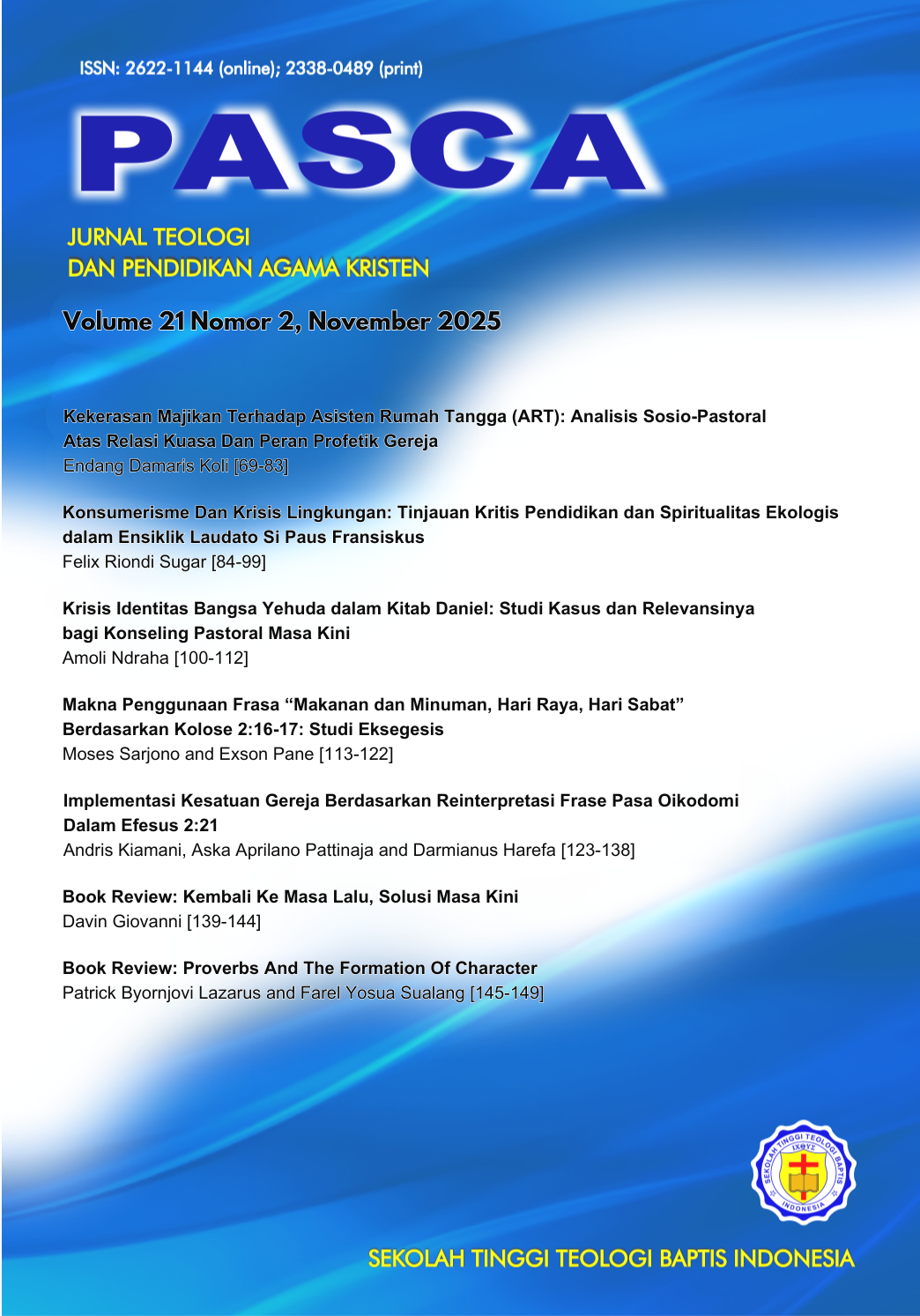
The Meaning of the Phrase “Food and Drink, Festivals, Sabbath Days” Based on Colossians 2:16-17: An Exegetical Study
DOI:
https://doi.org/10.46494/psc.v21i2.566Keywords:
sabbath, food, law, cleanAbstract
The use of the phrase "food and drink, festivals, and Sabbath days" in the context of the Colossian congregation has been misinterpreted and become a central point of debate regarding the Mosaic Law. Through an analysis of this text in Colossians 2:16-17, it will help address the notion that the dietary laws of clean and unclean foods and the Sabbath were not abolished through Jesus' death on the cross. This exegetical study aims to explore the meaning of the original language, connecting it historically and textually to perspectives on the law under examination. The study results indicate that "food and drink" do not refer to clean and unclean foods, and "Sabbath" does not refer to the weekly Sabbath but rather to the annual Sabbaths, also known as special festival days in the Jewish calendar. This shows that Paul was not emphasizing the abolition of God’s moral law, but was addressing ritual practices that were merely shadows of things to come namely, Christ Himself.
References
Bacchiocchi, Samuele. God’s Festivals in Scripture and History. 1st ed. Michigan: Biblical Perspectives, 2001.
Bergant, Dianne, and Robert J Karris. Tafsir Alkitab Perjanjian Lama. Translated by A S Hadiwiyata. Yogyakarta: Kanisius, 2002.
Browning, W R F. Kamus Alkitab: A Dictionary of the Bible. Panduan Dasar Ke Dalam Kitab Kitab, Tema, Tempat, Tokoh Dan Istilah-Istilah Alkitabiah. Translated by Liem Kiem Yang and Bambang Subandrijo. Jakarta: Gunung Mulia, 2014.
Bruce, F F. The Epistle to the Collossians, to Philemon, and to Ephesians. Grand Rapids: Eerdmans Pub. Co, 1984.
Cody, Aelred. Heavenly Sanctuary and Liturgy in the Epistle to the Hebrew. St. Meinrad, IN: Grail Publications, St. Meinrad Archabbey, 1960.
Elwell, Walter A, and B J. Baker Beitzel. Baker Encyclopedia of the Bible. Grand Rapids, Mich: Baker Book House, 1988.
Erdman, Charles Rosenbury. The Epistles of Paul to the Colossians and to Philemon. Philadelphia: Westminster Press, 1993.
Fausset, A R. Bible Cyclopaedia Critical and Expository. Harford: The S. Scranton Company, 1911.
Feldman, Melville W. The World University Encyclopedia. Washington DC: Publishers Company, Inc, 1966.
Friberg. “Analytical Greek Lexicon.” BibleWorks 10 (n.d.).
Fu, Timotius. Perhentian Hari Sabat: Makna Dan Aplikasinya Bagi Orang Kristen. Veritas: Malang, 2010. https://doi.org/10.36421/veritas.v11i2.230.
Gettys, Joseph M. How to Study Phlipians, Colossians & Philemon. Virginia: John Knox Press, 1999.
Giem, Paul. Sabbaton in Col. 2:16. Berrien Springs: Andrews University Seminary Studies, 1981.
Gingrich, Greek N.T.Lexicon. “BibleWorks 10, s.v. Σκιὰ,” n.d.
God, United Church. “Colossians 2 Verse 16 Shows Gentile Christians Observed the Biblical Holy Days,” n.d.
Gorman, Michael J. Elements of Biblical Exegesis: A Basic Guide for Students and Ministries. Michigan: Baker Academic, 2008.
Gromacki, Robert G. New Testament Survey. Grand Rapids, MI: Baker Academic, 1974.
Grudem, Wayne. Systematic Theology: An Introduction to Biblical Doctrine. Grand Rapids: Zondervan, 2020.
Gundry, Robert H. A Survey of the New Testament. 3rd ed. Manila, Philippines: OMF Literature Inc, 1994.
Hagelberg, Dave. Tafsiran Surat Kolose Dari Bahasa Yunani. Translated by Yohanes Effendi. Yogyakarta: ANDI offset, 2013.
Holmes, M. W. “Letter to the Collosians” in New Testament Dictionary of New Testament Theology. Colin Brow. Grand Rapids, MI: Zondervan, 1986.
Kasih, Yayasan Komunikasi Bina. Ensiklopedia Alkitab Masa Kini: M-Z. Jakarta: Yayasan Komunikasi Bina Kasih, n.d.
Lightfoot, J.B.St. Paul’s Epistle to the Galatians. Andover: W. F. Draper, 1870.
Mark Finley. Hari Yang Hampir Dilupakan . Bandung: Indonesia Publishing House, 1992.
Marshaal, J W. Decalogue” in Dictionary of the Old Testament: Pentateuch, 2d. Edited by T.Desmond Alexander and Dacid W Baker. Downers Grove, Ill: InterVarsity Press, 2003.
Nichol, Francis D. “Seventh-Day Adventist Bible Commentary (SDABC), Rev. Ed.” In “Decalogue” in Dictionary of Seventh-Day Adventist Bible Commentary (SDABC), Rev. Ed., edited by Francis D Nichol, Revised., 183. Washington DC: Review & Herald,1976-1980, 1980.
Ross, J F. “"Food” The Interpreter’s Dictionary of the Bible: An Illustrated Encyclopedia.” In "Food” The Interpreter’s Dictionary of the Bible: An Illustrated Encyclopedia, edited by Ed George Arthur Buttrick, George Art., 304. Nashvillle: Abington, 1981.
Scott, E F. The Moffatt New Testament Commentary: The Epistle to The Collossians. London: Hodder and Stoughton, 1930.
Simpson, Edmund K, and Frederick F Bnice. Commentary on the Epistles to the Ephesians and Colossians. Grand Rapids: Eerdmans Pub. Co, 1975.
Singgih, Emanuel Gerrit, and Nindyo Sasongko. “MATI DAN BANGKIT BERSAMA KRISTUS: Sebuah Spiritualitas Kristen Berdasarkan Refleksi Biblis Kolose 2: 16–3: 4.".” Asosiasi Teolog Indonesia: Indonesian Journal of Theology 5, no. 2 (2017): 17. https://doi.org/10.46567/ijt.v5i2.25.
Smith, T C. Acts” in The Broadman Bible Commentary. Nashville: Broadman, 1970.
“The Historical-Grammatical Method Is a Modern Christian Hermenutical Method.” “Historical Grammatical Method” Wikipedia, n.d.
Wells, Jan. Colossians. United State: Xulon Press, n.d.
Yamuchi, Edwin M. Pre-Christian Gnosticism. Grand Rapids: Eerdmans Pub. Co, 1973.
Downloads
Published
How to Cite
Issue
Section
License
Copyright (c) 2025 Moses Sarjono, Exson Pane

This work is licensed under a Creative Commons Attribution-ShareAlike 4.0 International License.

PASCA: Jurnal Teologi dan Pendidikan Agama Kristen is licensed under a Creative Commons Attribution-ShareAlike 4.0 International License.