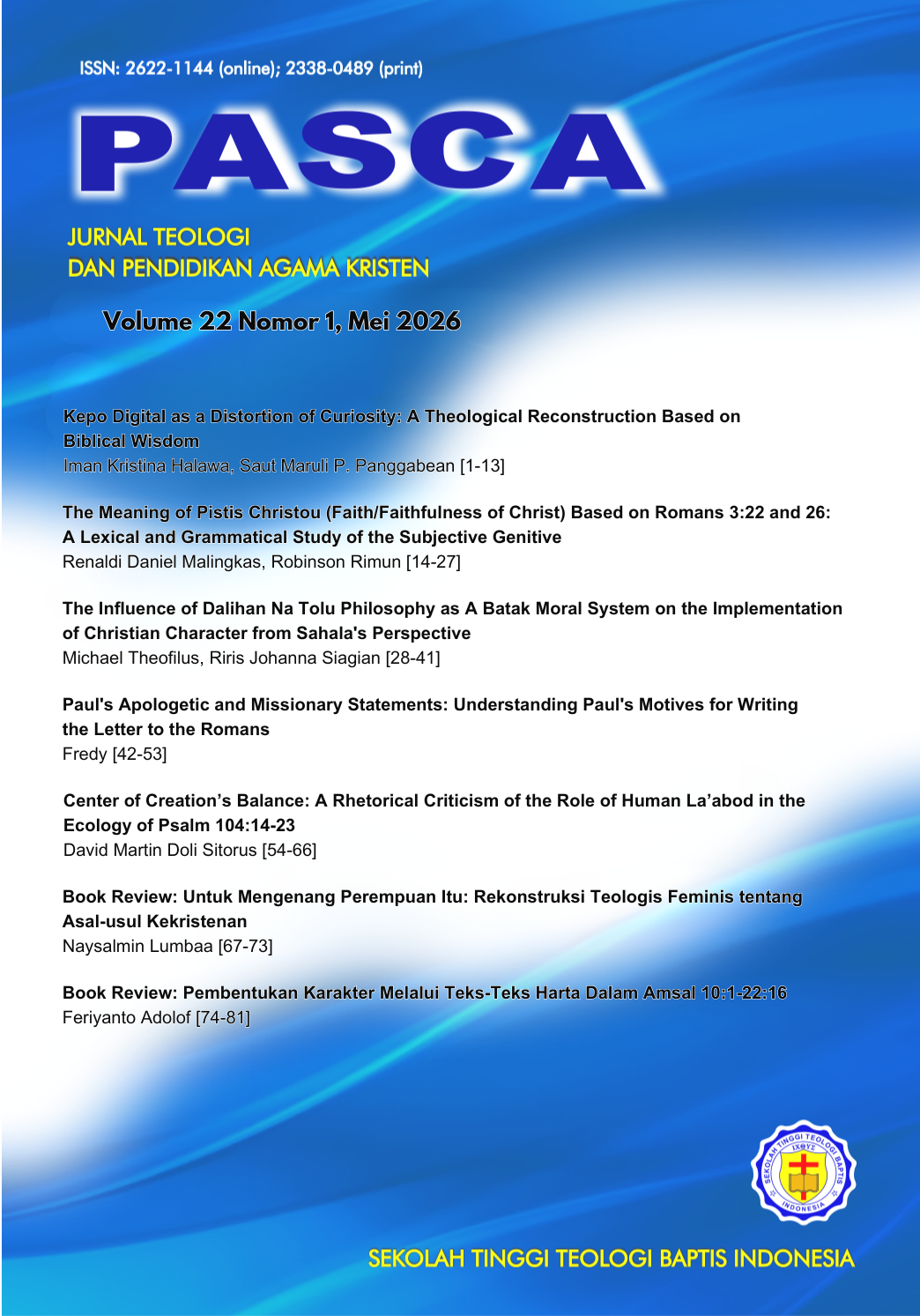
The Meaning of Pistis Christou (Faith/Faithfulness of Christ) Based on Romans 3:22 and 26: A Lexical and Grammatical Study of the Subjective Genitive
DOI:
https://doi.org/10.46494/psc.v22i1.599Keywords:
Pistis Christou, faithfulness of Christ, subjective genitive, Pauline soteriology, Romans 3:22–26Abstract
This article examines the meaning of the phrase pistis Christou in Romans 3:22 and 26 through lexical, grammatical, and hermeneutical analysis to determine whether the genitive construction refers to human faith in Christ (objective genitive) or Christ’s faithfulness to God (subjective genitive). Employing a qualitative library research method, the study applies exegetical steps including historical, literary, and theological contextual analysis; syntactical examination of Koine Greek; and semantic investigation of pistis in the Septuagint and Pauline writings. The findings indicate that the semantic field of pistis is best understood as “faithfulness” or “allegiance” rather than merely cognitive belief, and syntactically, the genitive pistis Christou favors a subjective reading. Within Paul’s theological framework, this interpretation emphasizes that justification is grounded not in human faith but in Christ’s faithfulness and obedience to the Father, culminating in His death on the cross. This conclusion shifts the soteriological focus from an anthropocentric to a Christocentric paradigm, consistent with Romans 5:19, which affirms that through the obedience of one man, many will be made righteous. Thus, salvation is presented as God’s act of grace, actualized through Christ’s faithfulness, while human faith functions as a participatory response to Christ's completed redemptive work.
References
Alinurdin, David. “Konsep Kebenaran Allah Menurut Rasul Paulus Di Dalam Surat Roma.” Veritas: Jurnal Teologi dan Pelayanan 17, no. 1 (2018): 1–14. https://doi.org/10.36421/veritas.v17i1.302.
Balz, Horst, and Gerhard Schneider. Exegetical Dictionary of the New Testament. Vol. 1–3. Vols. Grand Rapids, MI: Eerdmans, 1990.
Bauer, Danker, Arndt, and Gingrich. A Greek-English Lexicon of the New Testament and Other Early Christian Literature. 3rd ed. Chicago: University of Chicago Press, 2000.
Bibles, Crossway. The Holy Bible: English Standard Version. Wheaton, IL: Crossway, 2016.
Biblica. Holy Bible: New International Version. Grand Rapids, MI: Zondervan, 2011.
Boangmanalu, Mestriyati, Warseto F Sihombing, Hanna Dewi Aritonang, Robert J T Sitio, and Reymond P Sianturi. “Kajian Teologis tentang Konsep Keselamatan karena Anugerah menurut Roma 3:23-26 dan Relevansinya terhadap Pemahaman Jemaat GKPPD Masa Kini.” Tri Tunggal: Jurnal Pendidikan Kristen dan Katolik 2, no. 4 (2024): 289–303. https://doi.org/10.61132/tritunggal.v2i4.725.
Bura, Restia Nata, Sindi Arnita Tulak, and Lin Lin. “Teologi Paulus Tentang Makna Salib.” Jurnal Teologi dan Pendidikan Agama Kristen 4, no. 2 (2022): 11–25. https://doi.org/10.55606/corammundo.v4i2.21.
Easter, Matthew C. “The Pistis Christou Debate: Main Arguments and Responses in Summary.” Journal Currents in Biblical Research 9, no. 1 (2010): 33–47. https://doi.org/10.1177/1476993X0936072.
Eddy, Paul Rhodes, James Beilby, and Steven Enderlein. “Justification in Contemporary Debate.” In Justification: Five Views, edited by Ed James K Beilby, Paul Rhodes Eddy, and Steven E Enderlein. Downers Grove, IL: IVP Academic, 2011.
Enderlein, Steven E. “The Faithfulness of the Second Adam in Romans 3:21–26: A Response to Porter and Cirafesi.” Journal for the Study of Paul and His Letters 3, no. 1 (2013): 11–24.
Fee, Gordon. New Testament Exegesis: A Handbook for Students and Pastors. 3rd Ed.). Westminster John Knox Press, 2002.
Hooker, Morna D. “Another Look at Πίστις Χριστοῦ.” Scottish Journal of Theology 69, no. 1 (2016): 46–62. https://doi.org/10.1017/S0036930615000770.
Howard, George. “Faith: ‘Faith of Christ.’” In The Anchor Yale Bible Dictionary, edited by Ed David Noel Freedman. New York: Doubleday, 1992.
Iswahyudi, Iswahyudi, and Bobby Kurnia Putrawan. “Justification by Faith Paul: A Biblical Theological Approach.” International Journal of Social Science Research and Review 5, no. 5 (2022): 60–66. https://doi.org/10.47814/ijssrr.v5i5.330.
Kittel, and Geoffrey Bromiley. Theological Dictionary of the New Testament. Grand Rapids: Eerdmans, 1976.
Kostenberger, Andreas, Benjamin Merkle, and Robert Plummer. Going Deeper with New Testament Greek, Revised Edition: An Intermediate Study of the Grammar and Syntax of the New Testament. B&H Academic, 2020.
Lee, Jongchul. “A New Reading of Paul’s Justification in Romans 3:21-26.” Institute of Theological Studies 78 (2021): 33–58. https://doi.org/10.46334/ts.2021.06.78.33.
Matlock, Barry. “The Rhetoric of Πιστις in Paul: Galatians 2.16, 3.22, Romans 3.22, and Philippians 3.9.” Journal for the Study of the New Testament 30, no. 2 (2007): 173–203. https://doi.org/10.1177/0142064X07084775.
McRay, John. Paul: His Life and Teaching. Grand Rapids, MI: Baker Academic, 2003.
Morgan, Teresa. Roman Faith and Christian Faith: Pistis and Fides in the Early Roman Empire and Early Churches. Oxford University Press, 2015.
Panjaitan, Yuni Karlina, Exsanti Marani, and Daud Balang. “Titik Temu Teologi Paulus Dan Yakobus Mengenai Pembenaran Hanya Melalui Iman.” Skenoo : Jurnal Teologi dan Pendidikan Agama Kristen 3, no. 2 (2023): 196–211. https://doi.org/10.55649/skenoo.v3i2.41.
Rahlfs, Alfred, and Robert Hanhart. Septuaginta. Editio Alt. Stuttgart: Deutsche Bibelgesellschaft, 2006.
Schliesser, B. “‘Exegetical Amnesia’ and I TI XPI TO : The ‘Faith of Christ’ in Nineteenth-Century Pauline Scholarship.” The Journal of Theological Studies 66, no. 1 (2015): 61–89. https://doi.org/10.1093/jts/flv008.
Sihombing, Warseto Freddy, and Marlinawati Situmorang. “Studi Analisis-Teologis Pembenaran Oleh Iman Dalam Surat Roma.” Journal Teologi Cultivation 5, no. 2 (2021): 103–19. https://doi.org/10.46965/jtc.v5i2.909.
Smith, Julien. The Faithfulness of the Risen Christ: Pistis and the Exalted Lord in the Pauline Letters. Translated by David J Downs and Benjamin J Lappenga. Baylor University Press, 2019.
Tambun, Roy Haries Ifraldo. “Dibenarkan Oleh Iman, Bukan Perbuatan: Refleksi Pembenaran Menurut Roma 3:21-31.” KHARISMATA: Jurnal Teologi Pantekosta 8 8, no. 1 (2025): 1–19. https://doi.org/10.47167/7mj5e053.
Umboh, Sonny Herens. Pembimbing Dan Pengetahuan Perjanjian Baru 1. Sumedang: Mega Press Nusantara, 2024.
Utomo, Karyo. Teologi Pembenaran: Pandangan Paulus Dalam Kitab Roma. Jawa Timur: Uwais Inspirasi Indonesia, 2019.
Wallace, Daniel B. Greek Grammar Beyond the Basics: An Exegetical Syntax of the New Testament. Grand Rapids, MI: Zondervan, 1996.
Whitenton, Michael R. “After ΠiΣtiΣ XpiΣtoy: Neglected Evidence from the Apostolic Fathers.” The Journal of Theological Studies 61, no. 1 (2010): 82–109. https://doi.org/10.1093/jts/flq045.
Witherington, Ben, and Darlene Hyatt. Paul’s Letter to the Romans: A Socio-Rhetorical Commentary. Grand Rapids, MI: Eerdmans, 2004.
Downloads
Published
How to Cite
Issue
Section
License
Copyright (c) 2026 Renaldi Daniel Malingkas, Robinson Rimun

This work is licensed under a Creative Commons Attribution-ShareAlike 4.0 International License.

PASCA: Jurnal Teologi dan Pendidikan Agama Kristen is licensed under a Creative Commons Attribution-ShareAlike 4.0 International License.